
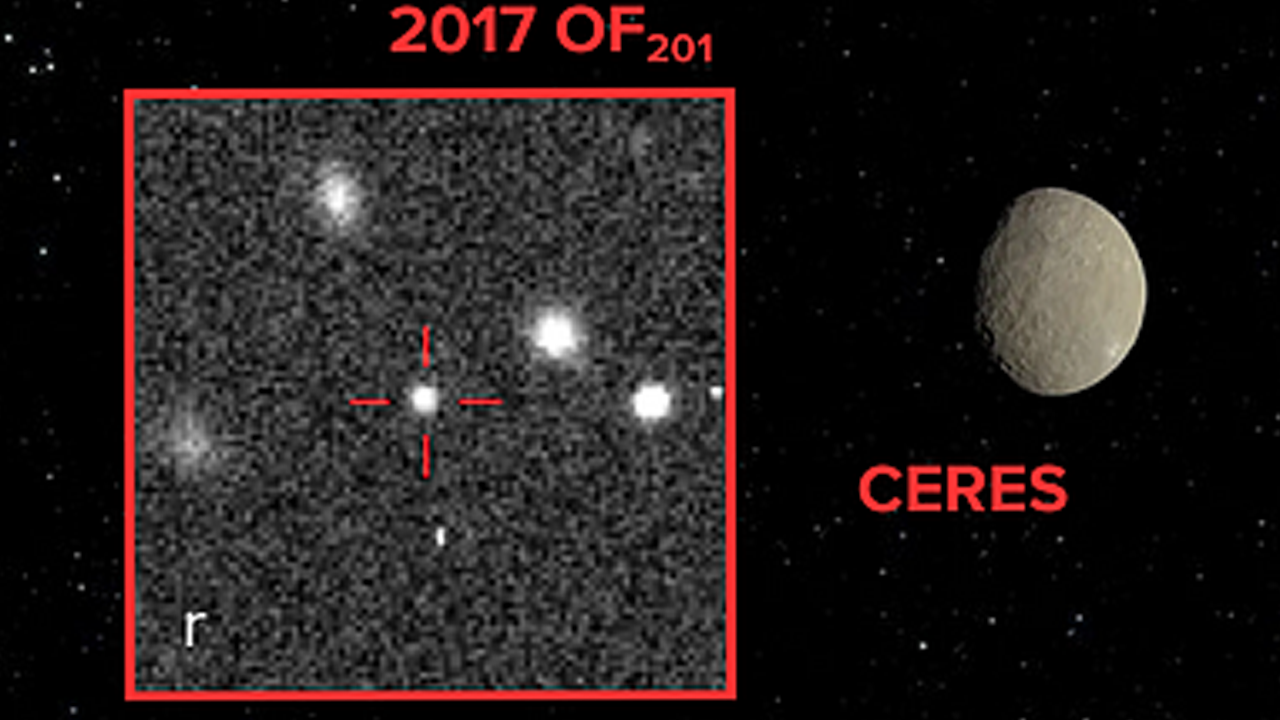
**Scientists Discover New Distant Object in Solar System, Offering Clues About the Elusive ‘Planet Nine’**
In a groundbreaking discovery that may reshape our understanding of the outer reaches of the solar system, a team of scientists at the Institute for Advanced Study’s School of Natural Sciences in Princeton, New Jersey, have identified a new trans-Neptune object (TNO) with unique characteristics. This finding not only adds to the catalog of distant solar system bodies but also provides tantalizing evidence in support of the existence of a hypothetical massive planet, sometimes referred to as ‘Planet Nine’ or ‘Planet X.’
### The Discovery
The newly found object, temporarily designated 2017OF201, was detected beyond the Kuiper Belt, a region filled with icy remnants from the early solar system. TNOs are minor planets that orbit the sun at distances greater than Neptune, the eighth and most distant officially recognized planet in our solar system. While astronomers have cataloged numerous TNOs, 2017OF201 stands out because of its unusually large size and the extreme parameters of its orbit.
The discovery was led by Sihao Cheng, along with fellow researchers Jiaxuan Li and Eritas Yang from Princeton University. Utilizing advanced computational techniques, the team was able to parse through astronomical data and identify the object’s distinctive trajectory across the sky. According to Cheng, what makes 2017OF201 exceptional is the vast distance it travels from the sun during its orbit.
### An Orbit Like No Other
2017OF201’s orbital path is nothing short of extraordinary. Its aphelion—the point in its orbit farthest from the sun—is more than 1,600 times the distance between Earth and the sun (an astronomical unit, or AU). Its perihelion, or closest approach to the sun, is about 44.5 AU, which is comparable to Pluto’s closest approach. For context, Neptune orbits at roughly 30 AU from the sun, and Pluto’s average distance is about 39.5 AU.
Because of this elongated and distant trajectory, the object takes approximately 25,000 years to complete a single orbit around the sun. Eritas Yang, a member of the discovery team, suggests that such an orbit likely resulted from a dramatic gravitational encounter with a giant planet at some point in its past. This encounter could have slingshotted the object into its current, highly eccentric orbit.
Cheng further theorizes that the object's journey may have been even more complex, possibly involving a sojourn in the Oort Cloud, the most distant region of the solar system known to be home to many comets. It’s possible, he speculates, that 2017OF201 was first ejected to the Oort Cloud and then sent back inward, further emphasizing the dynamic and often chaotic nature of our solar system’s outskirts.
### Why This Matters: Clues to a Hidden Giant
The discovery of 2017OF201 has significant implications for our understanding of the structure and evolution of the solar system’s outer regions. For years, astronomers have been puzzled by the peculiar orbits of several distant TNOs—some of which appear to cluster or align in ways that defy simple explanations. This has led to the development of the ‘Planet Nine’ hypothesis.
In January 2016, California Institute of Technology (Caltech) astronomers Konstantin Batygin and Mike Brown published research proposing that a yet-undetected planet—roughly 1.5 to 10 times the mass of Earth—could be lurking far beyond Neptune. This theoretical planet, sometimes dubbed ‘Planet X’ or ‘Planet Nine,’ would orbit at an average distance 15 to 30 times farther from the sun than Neptune and require between 10,000 and 20,000 years to complete one circuit.
Importantly, the existence of Planet Nine remains unproven; it has not been directly observed. Instead, its presence is inferred from the gravitational influence it appears to exert on other, smaller objects in the outer solar system. The odd orbits of several TNOs, including their unexpected clustering and tilts, can be explained if a massive, unseen planet is shepherding them with its gravity.
### Expanding the Solar Frontier
Prior to discoveries like 2017OF201, many astronomers assumed the region beyond the Kuiper Belt to be largely empty, save for the distant Oort Cloud. The identification of large TNOs in this