
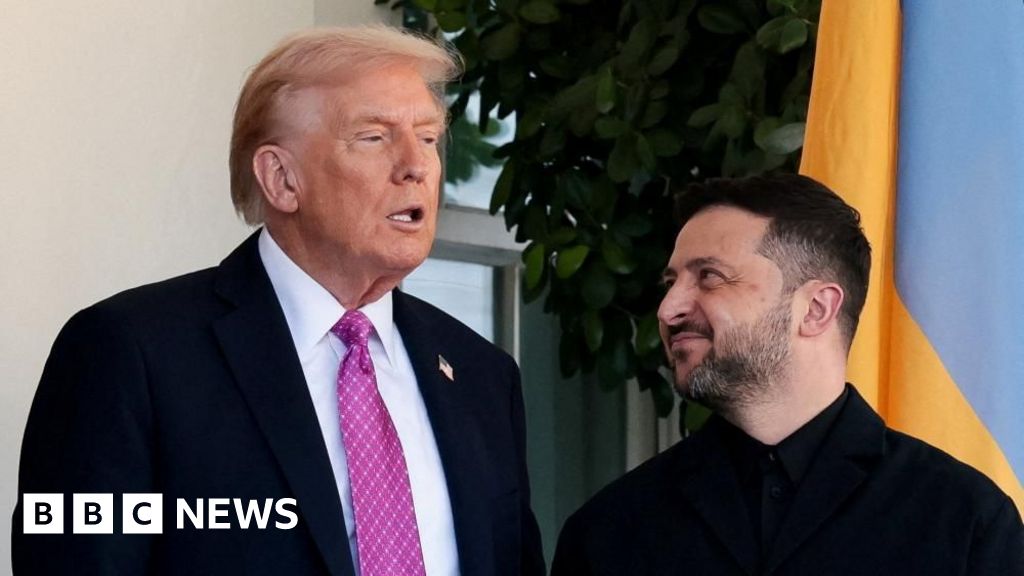
**Summary of the Article: Zelensky’s Difficult Visit to Washington and the Future of U.S. Support for Ukraine**
In recent days, Ukrainian President Volodymyr Zelensky made a high-profile visit to Washington, D.C., for a meeting with U.S. President Donald Trump, hoping to secure stronger support for Ukraine as it continues its war with Russia. However, the outcome of the visit was far from what the Ukrainians had anticipated, and the mood turned from optimism to disappointment in a matter of hours. The trip highlighted the complexity of Ukraine’s position, the unpredictability of U.S. foreign policy under Trump, and the continued resilience of the Ukrainian people.
**Optimism Before Departure**
The Ukrainian delegation departed for Washington in high spirits. Ruslan Stefanchuk, the speaker of Ukraine’s parliament and a close ally of Zelensky, described the trip as a “very important historical moment.” There was a palpable sense of anticipation that the visit would be a turning point in U.S.-Ukrainian relations. Stefanchuk was optimistic that the meeting would finally convince Trump of Russian President Vladimir Putin’s duplicity and the need for strong actions to end the war. One of Ukraine’s key objectives was to secure approval to use U.S.-supplied long-range Tomahawk missiles, which they hoped would tip the balance in their favor by increasing pressure on Russia.
Stefanchuk’s confidence before the trip was evident in his remarks to the BBC. He suggested that Trump was close to understanding that Putin could not be trusted and that a solution to the Tomahawk missile issue was within reach. The Ukrainian side seemed to believe that the meeting would demonstrate unity between Ukraine and the U.S., and send a clear message to the world—particularly to Russia—that the U.S. stood firmly behind Ukraine.
**A Changed Atmosphere Upon Arrival**
While Zelensky’s plane was still in the air, news broke of a lengthy two-and-a-half-hour phone call between Trump and Putin. The announcement that another Trump-Putin summit was being planned quickly followed. By the time the Ukrainian delegation landed, the atmosphere in Washington had shifted dramatically. The optimism that had accompanied the Ukrainians across the Atlantic evaporated, replaced by a sense of uncertainty and unease.
The American welcome was notably subdued. The contrast between the expectations before departure and the reality on arrival was stark. The Ukrainians had hoped for a show of solidarity and a clear commitment to their cause, but the developments in Washington suggested a more complicated picture.
Just weeks earlier, Trump had expressed clear frustration with Putin, describing his ongoing attacks on Ukraine as “crazy” and admitting he was growing “very angry” with the Russian leader. There was a sense that Trump’s patience was wearing thin and that he might be ready to take a tougher stance. But the mood had since shifted; the meeting with Zelensky revealed that Trump’s previous frustration had dissipated.
**A “Pointed” Conversation in the White House**
Zelensky later described his conversation with Trump as “pointed,” a word that hints at the tension and directness of the exchange. The meeting was not what the Ukrainians had hoped for. Trump, joined by his Secretary of State, War Secretary, and Treasury Secretary, sat sternly as prominent members of the MAGA (Make America Great Again) media watched from behind. The atmosphere was tense, and the risks for Zelensky were obvious—he knew from experience that directly challenging Trump in the White House could be dangerous.
Zelensky, ever the skilled diplomat, offered generous praise for Trump’s supposed peacemaking abilities and repeatedly expressed his gratitude. In today’s Washington, flattery is seen as an essential tool of diplomacy. Despite this, Zelensky made it clear that he did not share Trump’s newfound optimism about Russia’s intentions. “We understand that Putin is not ready,” Zelensky said, signaling his skepticism that Russia was negotiating in good faith.
Yet, the outcome of the meeting seemed preordained. Trump reiterated his belief that the war should be “frozen” at the current battle lines, with both sides simply “going home to their families.” This approach ignores the broader significance of the conflict for Ukraine and its allies, who see it as an existential fight against Russian aggression and imperial ambitions, not a petty dispute between leaders.
**Ukraine’s Requests Denied**
Ukraine’s key requests—to be allowed to use U.S. Tomahawk missiles and to receive