
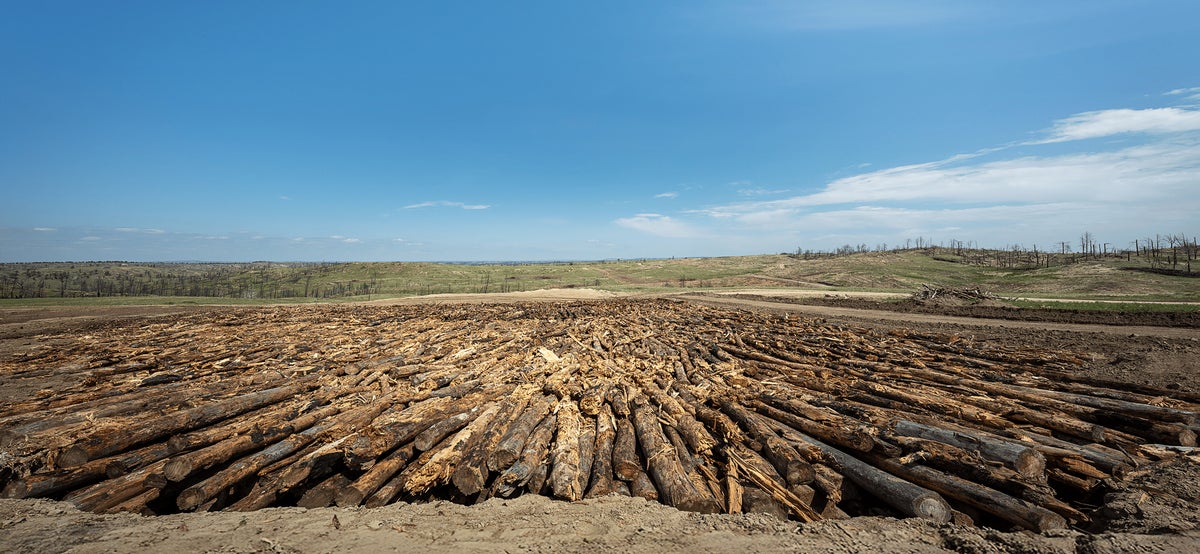
**Can We Bury Enough Wood to Slow Climate Change? A Deep Dive Into Wood Vaulting as a Carbon Solution**
As the world grapples with the pressing challenge of climate change, efforts to reduce greenhouse gas emissions remain slow and insufficient. This has led scientists and entrepreneurs to seek alternative strategies to mitigate global warming, particularly by removing carbon dioxide (CO₂) from the atmosphere. While much attention has been given to high-tech carbon capture technologies—such as machines that extract CO₂ directly from the air—these methods have yet to deliver results at the scale and speed required. Now, a remarkably simple and low-tech idea is gaining momentum: burying wood to lock away carbon for centuries or even millennia, a practice known as wood vaulting or biomass burial.
**The Science Behind Wood Burial**
At its core, wood burial leverages the natural process by which trees and plants absorb CO₂ from the atmosphere as they grow. Every year, terrestrial plants sequester about six times more carbon than is emitted by all human fossil fuel use. However, nearly all of this carbon is eventually returned to the atmosphere as plants die, decompose, or are burned. The key insight behind wood vaulting is to interrupt this cycle. By burying wood—logs, branches, wood chips, sawdust, and other woody debris—under soil, we can prevent it from decomposing and releasing its stored carbon back into the air.
The underlying mechanism is straightforward: when wood is buried under a few yards of dirt, oxygen becomes scarce. Without oxygen, the bacteria and fungi that normally break down wood cannot survive, dramatically slowing decomposition. As a result, the carbon remains locked within the buried wood for centuries or longer, effectively removing it from the active carbon cycle.
**Potential Impact on Climate Change**
A recent study published in *Nature Geoscience* suggests that wood burial could have a massive impact on global carbon removal efforts. Led by Yiqi Luo, an ecosystem ecologist at Cornell University, the research estimates that wood vaulting could store over 12 billion tons of CO₂ annually. This is a significant figure: the Intergovernmental Panel on Climate Change (IPCC) estimates that humanity must remove around 10 billion tons of CO₂ from the atmosphere each year by 2050 to limit global temperature rise to under 2°C (3.6°F) above pre-industrial levels.
The study goes further, predicting that if all suitable waste wood from global logging operations were buried rather than being burned or left to rot, this could cumulatively remove at least 770 billion tons of CO₂ by the end of the century. The result would be a reduction in global warming by at least 0.35°C (0.63°F), a seemingly modest shift that could nonetheless make the difference between catastrophic outcomes—such as the collapse of polar ice caps and coral reefs—and a more stable climate.
**Availability of Raw Materials**
One of the strengths of the wood vaulting approach is the sheer volume of wood available from human activities. Every year, trees in logging-focused forests take up about 170 billion tons of carbon, of which roughly 14 billion tons end up as wood products or waste. Most of this wood is eventually discarded in the form of branches, sawmill debris, landfilled furniture, or demolished buildings. According to Luo’s study, collecting and burying just this existing waste stream could meet or exceed the necessary carbon removal targets.
Ning Zeng, a climate scientist at the University of Maryland who has researched biomass burial for two decades, points out that even diverting a small percentage of the world’s decomposing wood could have a major impact. He emphasizes that terrestrial plants already absorb massive amounts of carbon—if we could simply prevent a fraction of that from returning to the atmosphere, we could greatly accelerate progress toward climate goals.
**From Theory to Practice: Real-World Efforts**
While calculating the theoretical potential of wood burial is an important first step, translating this into real-world practice is more complex. One challenge is accurately accounting for the carbon that is actually sequestered. As Kevin Fingerman, a carbon accounting expert at California State Polytechnic University, Humboldt, notes, it can be difficult to determine what would have happened to a given pile of wood if it had not been buried. Would it have decomposed quickly, or remained intact for years? Would it have been burned, emitting all its carbon at once, or used in long-lived products?
Despite