
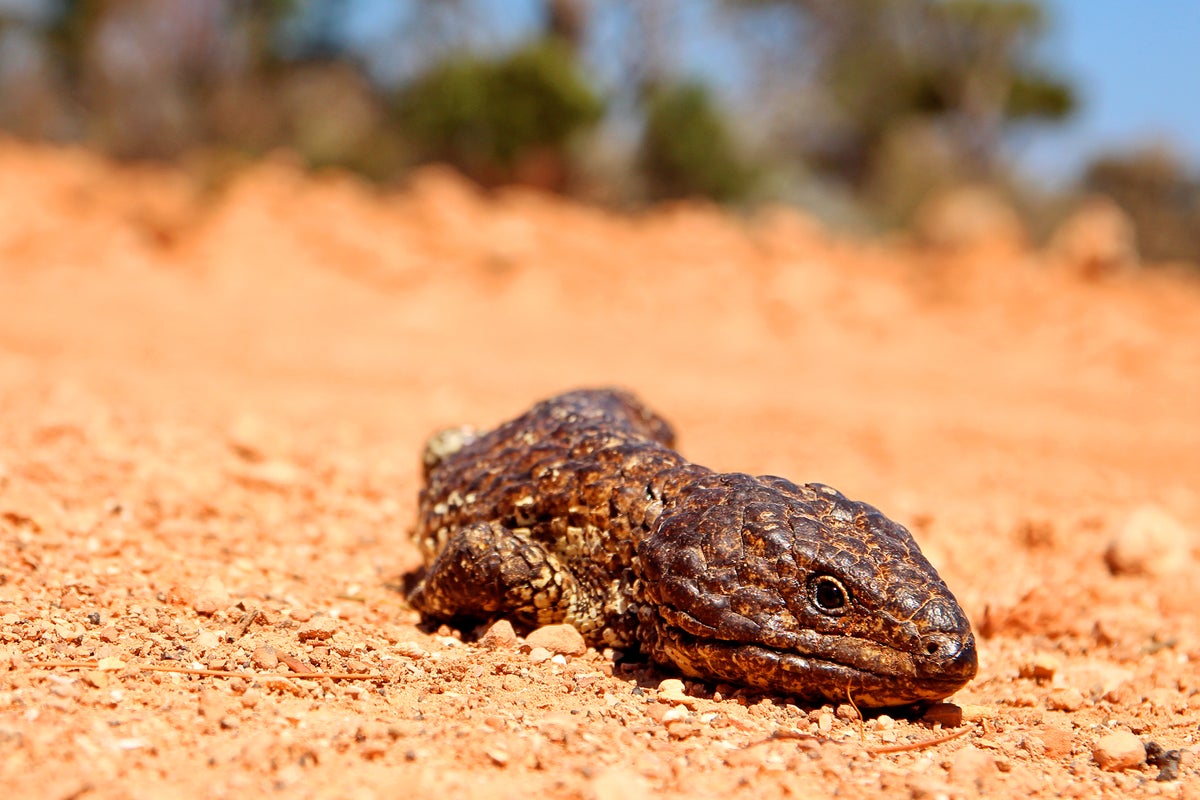
A surprising incident at the Audubon Zoo in New Orleans has shed new light on the remarkable abilities of a species of Australian lizard known as the sleepy lizard (Tiliqua rugosa), also called the shingleback skink or bobtail lizard. While these lizards are typically slow-moving and seemingly lethargic creatures, a lunch mishap involving smoke triggered an unexpected and intense reaction from them, revealing a hidden adaptation that may be crucial for their survival in fire-prone environments.
The event occurred when a zoo staff member accidentally burned their lunch, producing a plume of smoke that drifted into the enclosure housing the sleepy lizards. Immediately upon detecting the smoke, the lizards abruptly ceased their usual calm behavior. Their heads snapped up, tongues flicked rapidly, and their bodies tensed as they began pacing frantically around the edges of their enclosure and digging in the substrate, clearly attempting to escape. This response was striking because other reptiles housed in the same room did not exhibit any noticeable reaction to the smoke. The contrast sparked curiosity among scientists, raising the question of whether these Australian lizards had evolved a specialized ability to detect fire through its chemical signature.
To investigate this hypothesis, a team of researchers led by Chris Jolly, a conservation biologist affiliated with Macquarie University and Charles Darwin University in Australia, designed a controlled experiment. They exposed ten adult female sleepy lizards to various stimuli: puffs of smoke, water vapor, recordings of crackling wildfires, and white noise. The lizards reacted strongly and fled only in response to smoke, while remaining indifferent to water vapor and the auditory stimuli. These results, published in the journal Biology Letters, indicate that sleepy lizards rely primarily on their sense of smell—not hearing—to detect fire cues from a distance. This finding distinguishes them from other animals such as certain lizards, frogs, and bats that use auditory signals to perceive fires.
The reliance on olfaction aligns with what is already known about the sleepy lizard’s behavior and ecology. These lizards utilize scent for a variety of critical functions, including recognizing their lifelong mating partners, locating food, and detecting predators. Chris Jolly notes that smoke is an especially effective early warning signal because it often travels ahead of the actual flames and can penetrate through background environmental noise, making smell a more reliable sense to detect fire in the open, windy, and noisy landscapes where these lizards live.
An intriguing aspect of the study is that many of the lizards tested had likely never experienced wildfire firsthand. Their capture site had not burned for over 50 years, yet the lizards still exhibited an immediate and strong flight response when exposed to smoke. This suggests that the ability to detect smoke and respond accordingly is an innate adaptation rather than a learned behavior. The researchers also highlighted the contrast between the lizards’ usual slow, deliberate movements and their sudden urgency to escape when confronted with smoke. This behavioral shift challenges the “sleepy” moniker often used to describe these skinks, emphasizing that while they may generally be slow and docile, they can become highly alert and responsive when survival is at stake.
The discovery adds to a growing body of research exploring how animals adapt to fire-prone environments. Juli Pausas, a research scientist at the Spanish National Research Council who was not involved in the study, comments that while the sleepy lizards’ reaction to smoke likely represents an evolutionary adaptation to wildfire, additional studies are necessary to rule out alternative explanations, such as a general aversion to smoke’s toxic components. Nonetheless, she acknowledges that the study contributes valuable evidence toward recognizing that certain animal behaviors may have evolved specifically in response to fire, a subject that has been underexplored until recent years.
As wildfires become more frequent and intense due to climate change, understanding animals’ sensory adaptations to fire is increasingly important. The authors of the study suggest that the sleepy lizards’ ability to detect and flee from smoke could be a crucial survival mechanism in the face of escalating fire threats. Such adaptations may help these lizards and other species avoid injury or death during wildfires by enabling early detection and timely escape.
This research not only enhances our understanding of the sleepy lizard’s natural history but also sheds light on the broader ecological significance of fire as a selective pressure shaping animal behavior and physiology. It highlights the complex interplay between animals and their environments, where even creatures perceived as slow and inactive have evolved sophisticated mechanisms to cope with one of nature’s most destructive forces.
In sum