
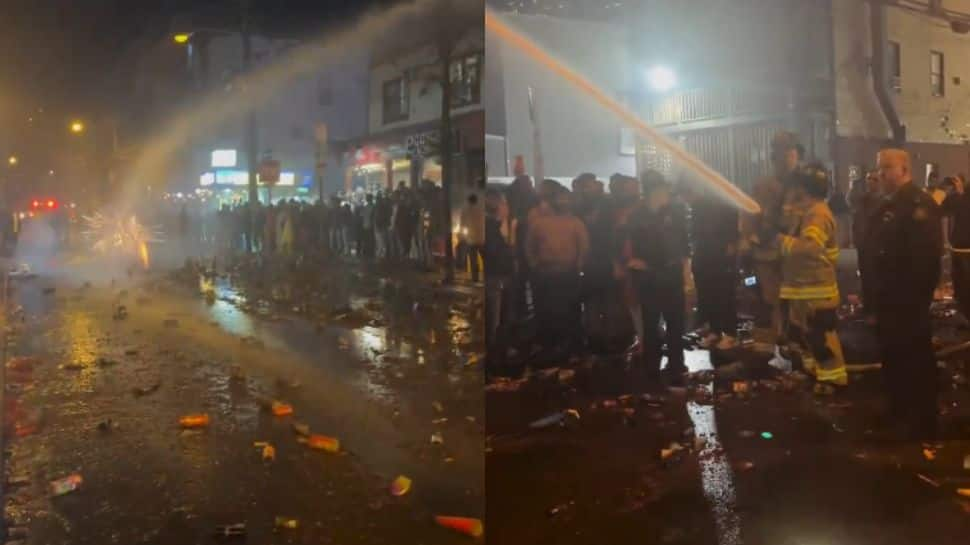
A video capturing Diwali celebrations in the United States has recently gone viral on social media platform X (formerly Twitter), sparking widespread discussion and debate. The footage shows a large crowd gathered on a public road late at night, enthusiastically bursting fireworks as part of the festive celebrations. However, the scene soon escalates when local police and fire department officials intervene to stop the fireworks display, citing safety regulations. The video and the incident have drawn mixed reactions online, highlighting the complex interplay between cultural expression and civic responsibility, both within Indian communities abroad and back home in India.
In the video, a sizable group of people can be seen lighting fireworks on a street, with loud explosions and cheers filling the air. As the celebrations continue past 10 pm, officials from the police and fire departments arrive on the scene and begin sprinkling water on the fireworks in an attempt to halt the activity. The authorities explained that the fireworks display was stopped because it was beyond the permitted time limit, violating local safety rules designed to prevent accidents and disturbances during late hours. Despite these efforts, the crowd remains vocal, cheering and hooting as officers try to regain control of the situation.
The video was posted by an Indian man on X, who captioned the clip with a critical message directed at the celebrants. His post read: “This US Diwali video is viral on Instagram. The USA Police & Fire Department had to intervene and stop fireworks — just look at the mess on the road. And then you cry when you are deported. Is this the image of India & Hindus you are creating in foreign lands?” This statement sparked significant online debate, with users expressing a wide range of opinions on the conduct of the people celebrating, as well as the broader implications for the Indian diaspora.
Many social media users condemned the behavior shown in the video, labeling it irresponsible and disrespectful to the local laws and environment. Some criticized the crowd for ignoring safety rules and causing a public nuisance, arguing that such actions reinforce negative stereotypes about Indians living abroad. One user sarcastically remarked, “Looked less like Diwali, more like disaster management training,” highlighting the chaotic nature of the scene and the heavy-handed response by emergency services.
Others were more direct in their criticism of the cultural insensitivity perceived in the video. Comments like “Indians love to move abroad but refuse to adopt local culture. Fine. But if you love your own culture that much, stay home... don’t litter, shout, and ruin public spaces,” pointed to a broader frustration with immigrants who do not integrate into their host societies. These voices called for a more respectful approach to celebrations that balances cultural pride with adherence to local norms and regulations.
Meanwhile, some users defended the celebrants, emphasizing the importance of cultural expression and community bonding during festivals like Diwali. They argued that as long as celebrations are conducted safely, they should be allowed to proceed without heavy restrictions. These defenders contended that Diwali is a significant and joyous occasion for Hindus worldwide, and that enforcing overly strict curbs dampens the spirit of the festival. They suggested that authorities could work with community leaders to designate suitable venues and times for fireworks, allowing celebrations to continue in a controlled and safe manner.
Another popular viewpoint focused on the practical aspects of celebrating abroad. Several commenters suggested that the group should have booked an open space and obtained the necessary permissions from authorities before organizing such a large fireworks display. This, they argued, would have allowed the celebration to proceed legally and safely, avoiding confrontations with police and fire departments. The call for better planning and cooperation pointed to a need for more dialogue between immigrant communities and local officials to ensure that cultural festivals can be enjoyed without causing public disorder.
Interestingly, many social media users drew parallels between the scene in the US and Diwali celebrations in India, particularly in Delhi. It was noted that despite bans and pollution warnings, people in Delhi often continue bursting firecrackers late into the night, creating similar noise and environmental disturbances. Some commenters used this comparison to highlight the ongoing challenges India faces in balancing traditional festivities with modern concerns such as pollution control and public safety. This comparison also underscored the universal tension between cultural customs and regulations designed to protect the wider community.
The viral video and the discussions it generated have thus brought to light the delicate balance immigrant communities must strike between preserving their cultural identity and respecting the laws and customs of their adopted countries. Celebrations like Diwali hold deep cultural and religious significance for millions of Hindus worldwide