
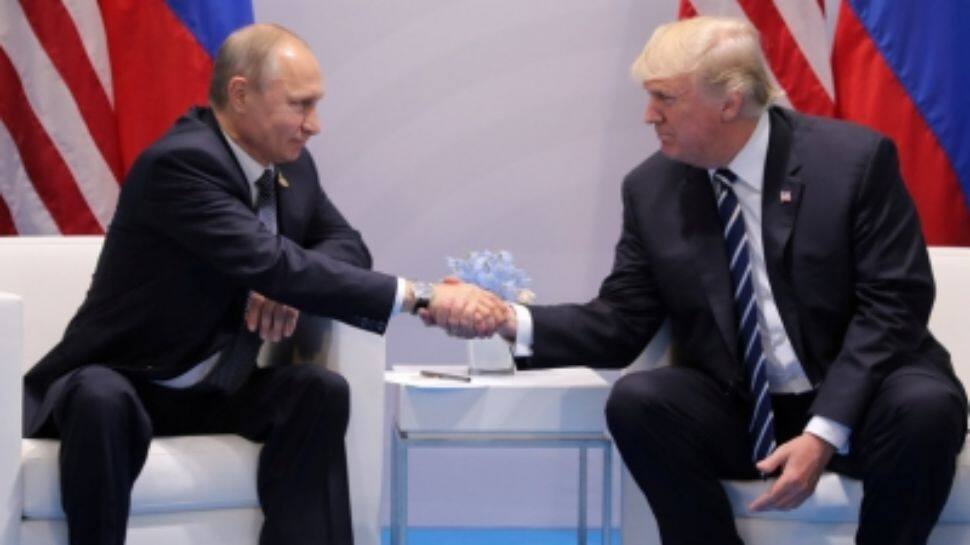
US President Donald Trump has announced the cancellation of his much-anticipated meeting with Russian President Vladimir Putin, citing a lack of progress in diplomatic negotiations aimed at resolving the ongoing conflict between Russia and Ukraine. Speaking at the White House, Trump expressed his disappointment over stalled talks, stating, “We cancelled the meeting with President Putin. It just didn’t feel right to me.” He further elaborated that despite prior discussions and plans to meet in Budapest, Hungary, the timing and circumstances were not conducive to productive dialogue. “It didn’t feel like we were going to get to the place we have to get. So I cancelled it, but we’ll do it in the future,” Trump added.
This decision comes amid heightened tensions and ongoing military operations in Ukraine, with Trump openly expressing frustration over the lack of tangible outcomes from his communications with Putin. “Every time I speak with Vladimir, I have good conversations, and then they don’t go anywhere. They just don’t go anywhere,” the US President noted. His remarks underscored the complexities of the conflict, describing it as a war between “two very competent sides,” and highlighted the unpredictability inherent in any war situation. Despite this, Trump emphasized his desire to see the conflict resolved, urging both leaders to “make a deal” to end the violence.
In tandem with the cancellation announcement, the White House revealed a new round of sanctions targeting key players in Russia’s oil industry. For the first time during his second term, Trump imposed sanctions on two of Russia’s largest oil companies, Rosneft and Lukoil, along with their subsidiaries. The US Treasury Department issued warnings that further actions targeting these firms could not be ruled out in the future. These measures are part of a broader strategy to increase economic pressure on Moscow, aiming to curtail its ability to sustain military operations in Ukraine.
Trump described the sanctions as “tremendous” and “very big” against Russia’s major oil firms but expressed hope that they would be temporary. While meeting with NATO Secretary General Mark Rutte at the White House, Trump conveyed optimism that the “war will be settled” soon. The sanctions reflect a significant step in the US administration’s approach, combining diplomatic efforts with economic tools to influence the course of the conflict.
The cancellation of the meeting followed a phone call between US Secretary of State Marco Rubio and Russian Foreign Minister Sergey Lavrov earlier in the week. This interaction, along with ongoing diplomatic exchanges, seemingly confirmed the difficulties in reaching a breakthrough at this stage. Just the week before, Trump had a lengthy two-and-a-half-hour phone conversation with Putin, which he initially described as having made “great progress.” However, the subsequent change in tone and the decision to cancel the summit highlighted the volatile and uncertain nature of the negotiations.
Adding another layer to the diplomatic efforts, Trump hosted Ukrainian President Volodymyr Zelensky at the White House shortly after his call with Putin. The meeting was described as “very interesting and cordial,” demonstrating the US commitment to supporting Ukraine while simultaneously engaging with Russia. On his social media platform Truth Social, Trump stated, “I told him, as I likewise strongly suggested to President Putin, that it is time to stop the killing, and make a DEAL!” He also suggested that both leaders consider “stopping where they are” and “claim victory,” a proposal aimed at encouraging a ceasefire and peace agreement.
Trump’s focus on the Russia-Ukraine conflict has intensified following his involvement in mediating a ceasefire in Gaza, signaling a shift in his international diplomatic priorities. His efforts to broker peace between Moscow and Kyiv have been highly publicized, though previous attempts, including a notable summit with Putin in Alaska last August, ended without any agreements. The current cancellation marks another setback but also reflects the challenges inherent in navigating such a complex geopolitical crisis.
Throughout this period, Trump has maintained that dialogue with Putin remains open, despite the lack of concrete results. He acknowledged the difficulties posed by the ongoing war, emphasizing the need for both sides to come to the negotiating table seriously. “You never know with war, but I would say that it’s time to make a deal,” he remarked, underscoring his hope for a resolution.
The newly imposed sanctions targeting Rosneft and Lukoil are a clear signal of the US’s intent to utilize economic pressure as leverage in the diplomatic process. Rosneft and Lukoil are central to Russia’s oil production and export capacity, and restricting their operations is aimed at