
On October 27, 2025, a significant political development unfolded in Kerala involving the Communist Party of India (CPI) and the state government concerning the contentious PM SHRI (Prime Minister Schools for Rising India) scheme. The CPI has taken a firm stance demanding that the Kerala government either withdraw from the Memorandum of Understanding (MoU) it signed with the Central Government to implement the PM SHRI scheme or place the agreement in cold storage. In protest, the CPI announced it would boycott the state Cabinet meetings until the first week of November, with further decisions to be made at the party’s state council meeting scheduled for November 4.
The core of the CPI’s opposition lies in their belief that the government’s acceptance of the PM SHRI scheme goes against the party’s and the Left’s broader policies at the national level. The CPI leadership expressed dissatisfaction that the Kerala government embraced the scheme without consulting the Cabinet or the coalition partners, which they consider a breach of coalition norms. They view the PM SHRI initiative as part of a larger effort by the BJP-RSS combine to privatize, communalize, and centralize education in India – policies the CPI has consistently opposed.
D. Raja, the general secretary of the CPI, spoke candidly about the party’s position during a phone conversation with The Hindu. He dismissed the government’s justification that joining the scheme was necessary to avail federal funds, calling it unconvincing. Raja pointed out that states like Tamil Nadu had resisted the scheme and even challenged it legally. He questioned why Kerala could not take a similar stand, implying that the state should not compromise on its educational autonomy and principles just for financial considerations.
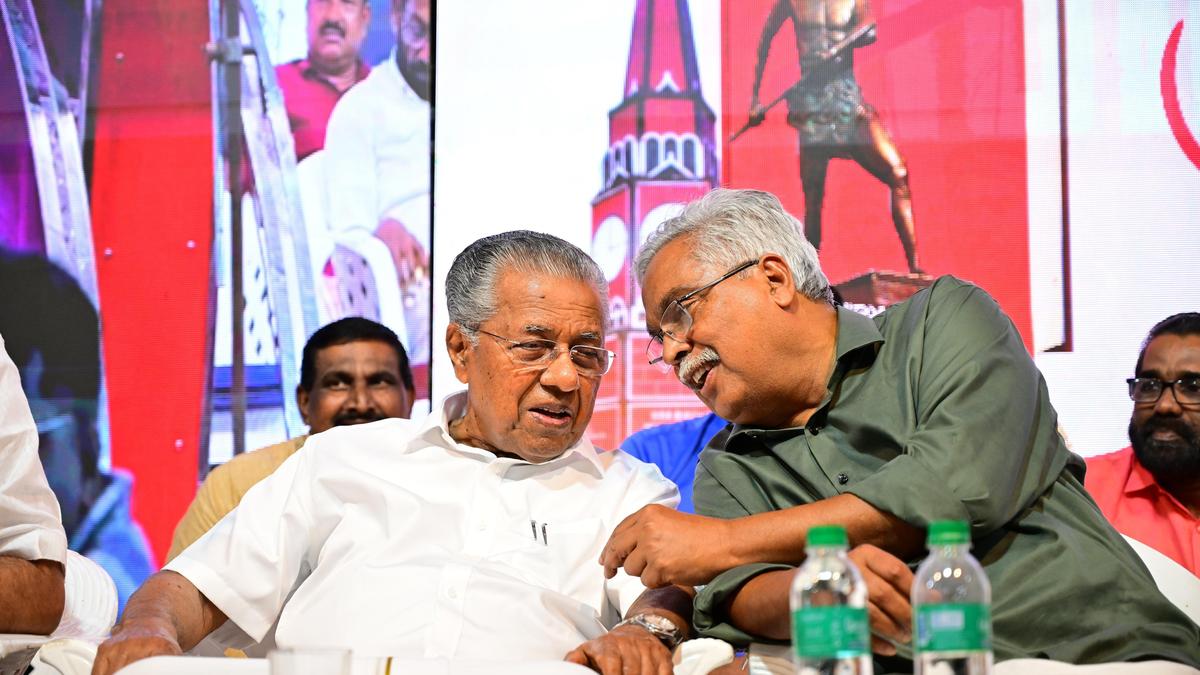
Efforts were made by Kerala’s Chief Minister Pinarayi Vijayan to resolve the impasse. He held meetings with CPI State Secretary Binoy Viswam and CPI ministers K. Rajan, G.R. Anil, and P. Prasad in Alappuzha, where the anniversary of the historic Punnapra-Vayalar uprising was being commemorated. However, these talks failed to resolve the conflict. Following the discussions, Binoy Viswam remarked that the government had not addressed the issues raised by the CPI, signaling ongoing dissatisfaction and tension within the coalition.
Further clarifying the CPI’s position, D. Raja stated in Delhi that the party would not accept anything less than either freezing or completely withdrawing the MoU with the Centre. He framed the issue within the context of the National Education Policy (NEP), which the CPI regards as “reactionary.” According to him, the BJP-RSS combine has effectively linked federal education funding – including PM SHRI and Samagra Shiksha Kerala (SSK) allocations – to implicit acceptance of the NEP. This, Raja suggests, is a coercive strategy aimed at reshaping India’s education system in ways that the CPI strongly opposes.
The CPI’s state secretariat and executive committee convened an urgent meeting in Alappuzha to discuss the matter. They strongly criticized the government’s “surreptitious” signing onto the PM SHRI scheme, especially since the Cabinet had deferred discussions on the subject twice within the Left Democratic Front (LDF) coalition. D. Raja was particularly categorical in asserting that the CPI(M), the dominant partner in the LDF, had disregarded the principles of coalition politics by proceeding without consensus. The CPI sees this as a serious breach that threatens the integrity of the coalition and its decision-making processes.
Despite the heightened tensions, Raja sought to quell speculation about the CPI possibly breaking away from the LDF coalition. There have been rumors fueled by invitations from various Congress leaders for the CPI to join the United Democratic Front (UDF), the main opposition coalition in Kerala. Raja dismissed these rumors as the views of some local leaders rather than the official party line. He pointed out that Congress-led governments in other states like Rajasthan, Telangana, and Karnataka had also joined the PM SHRI scheme, underlining that the CPI intends to continue fighting the issue from within the coalition rather than abandoning it.
The CPI’s protest highlights a broader political and ideological struggle over educational policy and federal-state relations in India. The PM SHRI scheme, launched by the Central Government, aims to elevate the quality of government schools through reforms and funding but has faced criticism from opposition parties who view it as an attempt to centralize control and introduce privatization and ideological shifts aligned with the ruling BJP-RSS agenda.
Kerala, known